
What’s the Best Way to Anchor a Printed Gazebo at an Outdoor Event?

A printed gazebo is a great way to create a branded, professional-looking space at outdoor events, markets, festivals, sports days and promotional activations.
However, one of the most important things to think about is how the gazebo will be anchored.
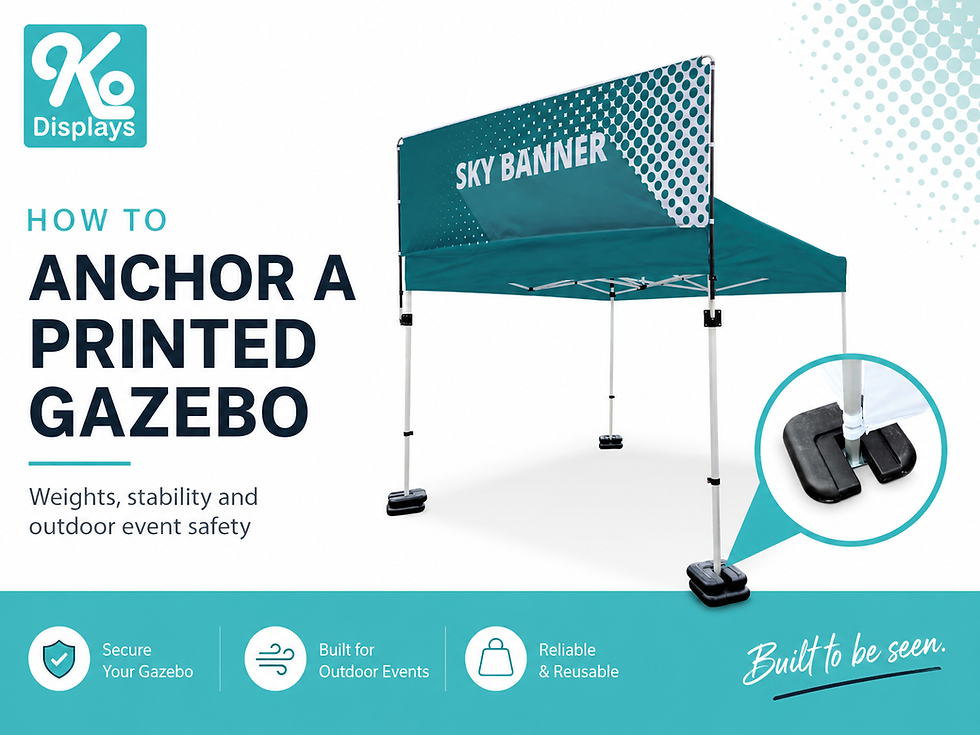
Even if the weather looks calm when you arrive, conditions can change quickly. A gazebo that is not properly weighted or anchored can become unsafe, so it is always worth planning this before the event.
Not sure how many weights you might need? Speak with an expert today
Why Gazebo Anchoring Matters
Outdoor displays are exposed to wind, movement and changing weather conditions.
A printed gazebo has a large surface area, especially when printed walls are added. This means it can catch the wind more than you might expect.
Proper anchoring helps keep the gazebo stable and reduces the risk of movement during the event.
It also helps you meet event organiser requirements, as many venues and outdoor event sites will ask for suitable weights or anchoring for safety and insurance reasons.
Check the Event Requirements First
Before choosing weights or anchors, it is always worth checking with the event organiser.
Some events have specific rules around what can and cannot be used. For example, a grass event may allow ground stakes, while a hard-standing event may only allow weights.
You may also be given a minimum weight requirement per leg.
Before the event, ask:
Is the event on grass, concrete, tarmac or indoor flooring?
Are ground stakes allowed?
Is there a minimum weight requirement?
Are water weights accepted?
Are there any restrictions on trip hazards?
Will the gazebo be used with printed walls?
Knowing this in advance helps avoid problems on the day.
Using Weights on Hard Ground
If your gazebo is being used on hard ground, such as concrete, tarmac or paving, weights are usually the best option.
Gazebo weights are placed around the legs to add stability and help keep the frame in position.
For outdoor events, we would normally recommend using at least one weight per leg. Where possible, using two weights per leg can provide extra stability, especially if the gazebo is being used with printed walls.
Weights are useful for:
markets
town centre events
car parks
forecourts
outdoor retail spaces
event sites where stakes are not allowed
Using Ground Stakes on Grass
If your gazebo is being used on grass or soft ground, ground stakes may be an option.
These are usually secured through the foot plates or guy ropes to help anchor the gazebo into the ground.
Ground stakes can work well on grass, but they are not always allowed at managed event sites, so it is important to check first.
They are commonly used for:
sports events
country shows
school events
festivals
outdoor community events
grass pitches or fields
Should You Use Weights and Ground Stakes Together?
Where possible, using both weights and ground stakes can provide additional stability.
This can be useful when the gazebo is being used for a full day, when printed walls are fitted, or when the event is in a more exposed location.
However, the best setup depends on the event site and what the organiser allows.
Printed Walls Can Affect Stability
Printed gazebo walls are a great way to increase branding and create a more professional event space.
However, walls can also catch the wind.
A gazebo with three printed walls attached will generally be more affected by wind than an open-sided gazebo.
This does not mean you should avoid printed walls, but it does mean anchoring becomes even more important.
If you are using printed walls, you should think carefully about:
how many walls are being fitted
whether the walls are single-sided or double-sided
the wind conditions on the day
whether the gazebo is in an exposed position
whether extra weights are required
One Weight Per Leg or Two?
As a general guide, at least one weight per leg is usually recommended for outdoor use.
For a standard 3x3m gazebo, that would mean four weights.
Where possible, using two weights per leg can give you a more secure setup, especially for busier or more exposed event spaces.
This is particularly useful if:
the gazebo has printed walls
the event is on hard standing
the space is exposed
the gazebo will be in place all day
the event organiser has strict safety requirements
Think About Public Safety
When anchoring a gazebo, it is not only about keeping the structure in place. It is also about making sure the setup is safe for people walking around it.
Weights, straps and ground stakes should be positioned carefully to reduce trip hazards.
If using guy ropes or straps, make sure they are clearly visible and not placed across busy walkways.
A professional-looking setup should also be a safe setup.
What If the Weather Is Too Windy?
Even with weights and anchors, there will be times when it is not safe to use a gazebo.
If the weather becomes too windy, the safest option may be to remove the walls, lower the structure or take the gazebo down completely.
Always follow the guidance provided with your gazebo and the instructions from the event organiser.
No branding opportunity is worth taking unnecessary safety risks.
Final Thoughts
The best way to anchor a printed gazebo depends on where it is being used.
For hard ground, weights are usually the most practical option.
For grass or soft ground, ground stakes may be suitable if permitted.
For extra stability, especially when using printed walls, additional weights or a combination of weights and stakes may be worth considering.
Before attending an outdoor event, always check the site conditions and event organiser requirements so you arrive prepared.
At KO Displays, we can supply printed gazebos, printed walls, weights, flags, tablecloths and other outdoor display products to help create a professional branded setup for your next event.


Comments